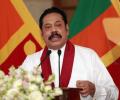
Rajapaksa's move signalled that he would contest the snap polls, to be held on January 5, under his own party banner and not that of Sirisena's SLFP.

Rajapaksa informed the lawmakers of United People's Freedom Alliance that he has resigned from the post.

Sri Lanka's newly elected president Mithripala Sirisena waves at media as he leaves the election commission in Colombo. Photograph: Dinuka Liyanawatte/ Reuters

Anura Kumara Dissanayake, the leader of the Marxist Janatha Vimukthi Peramuna's (JVP) broader front National People's Power (NPP), on Sunday consolidated his lead in the Sri Lanka's presidential election.

Over 15 million voters are eligible to vote in the election being held under electoral districts-based proportional representation system.

India welcomed resolution of the political crisis in Sri Lanka and exuded confidence that relations between the two countries will continue to move on in an upward trajectory.
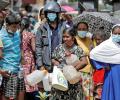
New Delhi has a chance to rid itself of its image as the bully in the subcontinent by helping a neighbour tackle problems that India, for once, has no role in creating. It should grab the opportunity with both hands, suggests Aditi Phadnis.
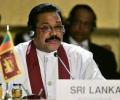
A defiant President Mahinda Rajapaksa on Sunday once again rejected demands for an international inquiry into alleged war crimes during the military campaign against the LTTE, saying countries should not "dictate" to Sri Lanka.

The country has a fiendishly complicated electoral system that is a combination of population-based proportional representation and party-based national lists, says Aditi Phadnis

Riled by Sri Lanka's request to defer the planned docking of a high-tech Chinese research vessel at the strategic Hambantota Port, China on Monday took a dig at India, saying it was "senseless to pressure" Colombo by citing the issue of security concerns.
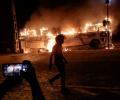
Sri Lanka has also imposed a police curfew in Western Province for six hours.

Sri Lanka President Maithripala Sirisena sacked Prime Minister Ranil Wickremesinghe and appointed former strongman Mahinda Rajapaksa as the new premier. Sirisena's move has triggered a constitutional crisis in the country. Here are some points about the unfolding crisis and the role of key players:
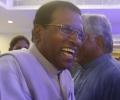
Maithripala Sirisena, Sri Lanka's president-elect, was a low-profile cabinet colleague of longtime president Mahinda Rajapaksa until he switched sides to become joint opposition candidate and emerge as the proverbial dark horse in the presidential polls.

A delegation from former president Maithripala Sirisena's Sri Lanka Freedom Party met him in the morning to press for their demand on the formation of the interim government.
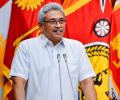
The dissidents, led by former president Sirisena's Sri Lanka Freedom Party, would leave the ruling Sri Lanka Podujana Peramuna coalition with its 14 Members of Parliament, party sources said after their meeting with the President on Monday.

Speaker Karu Jayasuriya questioned the president's decision to suspend parliament till November 16, saying it will have "serious and undesirable" consequences on the country.

The President had been moved out of his residence on Friday, in anticipation of Saturday's protests.

Mahinda Rajapaksa recovered from his 2015 electoral losses, went to the people and campaigned about the injustice done to him. Without attempting to be subtle, he underscored his image of the Sinhala Buddhist warrior a la Dutugemunu, the king of Sri Lanka (164 BC to 140 BC) who led the military campaign against the invading warlord Elara.
Rajapaksa was appointed as the premier on October 26 by President Maithripala Sirisena after sacking Ranil Wickremesinghe, plunging the nation into a constitutional crisis.

Rajapaksa has blamed India, the United States and European countries for his humiliating defeat.

'We have nothing to gain by helping any other country to become a threat to India,' former Sri Lanka president Mahinda Rajapaksa, who is on the comeback trail, tells Rediff.com in an exclusive interview.

Though dubbed as the "war hero", the role of Rajapaksa in ending the conflict with the Liberation Tigers of Tamil Eelam with the death of its supremo Velupillai Prabhakaran in 2009 is quite divisive as he stands accused of violating human rights, a charge he vehemently denies.

Sri Lankans were on the edge on Tuesday as they waited whether embattled Gotabaya Rajapaksa will honour his offer to resign as president, amid signs that key members of the erstwhile powerful ruling family were attempting to flee in the face of massive public anger against them for mishandling the economy that has bankrupt the country.

Sri Lanka's new Finance Minister Ali Sabry on Tuesday resigned, a day after President Gotabaya Rajapaksa appointed him after sacking his brother Basil Rajapaksa amidst the island nation's worst economic crisis.

Rajapaksa fled the country and resigned last month in the face of a popular uprising against his government for mismanaging the island nation's economy.
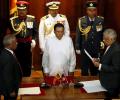
The swearing in ceremony was held inside the premises of the Presidential Secretariat at 9:30 am. President Sirisena administered the oath of office to 66-year-old Wickremesinghe, who has already served three times as the prime minister.
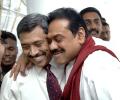
As the island heads for elections, two major factors worry Sri Lankan President Mahinda Rajapaksa. One is the division in the Sinhala vote and the other is the prospect of the Tamils and Muslims voting heavily against him.

Political analysts said Sirisena's move to install Rajapaksa as the prime minister could lead to a constitutional crisis as the 19th amendment to the Constitution would not allow the sacking of Wickremesinghe as the premier without a majority.
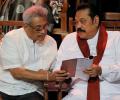
President Rajapaksa and Prime Minister Rajapaksa will transform Sri Lanka's political landscape after Thursday's electoral triumph, predicts N Sathiya Moorthy, veteran Colombo watcher.
Ending months of speculation, Sri Lanka's vanquished former president Mahinda Rajapaksa on Wednesday announced his return to electoral politics, saying he will lead an opposition faction during the general elections in August.

Sri Lanka's former president Mahinda Rajapaksa on Tuesday accepted defeat in the parliamentary elections even before the announcement of the final results.
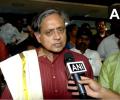
"It is high time India traded dynasty for meritocracy. This would require fundamental reforms, from imposing legally mandated term limits to requiring meaningful internal party elections, together with a concerted effort to educate and empower the electorate to choose leaders based on merit," Tharoor said.

Voters in Sri Lanka's Tamil majority Northern Province on Saturday began voting in the first local elections in 25 years to elect a council to govern the former war zone, four years after the military defeated the Liberation Tigers of Tamil Eelam after decades of bloody civil war.

Maithripala Sirisena was considered so meek and self-effacing that he appeared no threat to anyone. What a mistake his rivals made!

From Sri Lanka's most popular political family to its most despised -- going by the voices on the streets calling for the Rajapaksas' ouster -- what went wrong for the clan? Veteran Sri Lanka watcher N Sathiya Moorthy offers an insight.

'This was a decision taken and executed by Prabhakaran and his intelligence chief Pottu Amman. Both were convinced that the assassination would not be linked to them.'

After nearly two days of political deadlock, the stakeholders are engaged in prolonged talks to try and appoint a successor to Mahinda Rajapaksa.
India said it will continue to extend its developmental assistance to the friendly people of Sri Lanka.

'For the first time, all major countries are discovering India's indispensability to their own foreign policy interests.'

Though dubbed as the 'war hero', the role of Rajapaksa in ending the conflict with the LTTE with the death of its supremo Velupillai Prabhakaran in 2009 is quite divisive as he stands accused of violating human rights, a charge he vehemently denies.
 © 2026 Rediff.com - Advertise with us - Disclaimer - Privacy Policy - Sitemap - Feedback - About us - Terms of use - Grievances